The Experience Operator’s Guide to the EU Withdrawal Button
Tips & Advice


The Experience Operator’s Guide to the EU Withdrawal Button: What’s Exempt, What Isn’t, and How to Comply until June 19, 2026
June 19, 2026 is the date that every experience operator in Germany — and across the European Union — should have circled on their calendar. That’s when a new consumer protection framework (EU Directive 2023/2673, implemented in Germany via § 356a BGB) makes a self-service “Withdrawal Button” a legal requirement for a wide range of online bookings.
Here’s the problem: most operators believe they’re already off the hook.
“We only sell fixed-date tickets in Germany. The leisure exemption covers us.”
If that’s your assumption, read on — because there’s a good chance part of your product catalogue doesn’t qualify for that exemption at all.
The Leisure Exemption — and the EU Withdrawal Button Trap
German consumer law has long recognised that a tour operator can’t reasonably be expected to resell a slot at 2pm on a Saturday because a customer changed their mind on Friday night. So § 312g (2) No. 9 BGB explicitly exempts fixed-date leisure services from the statutory 14-day right of withdrawal.
That exemption covers:
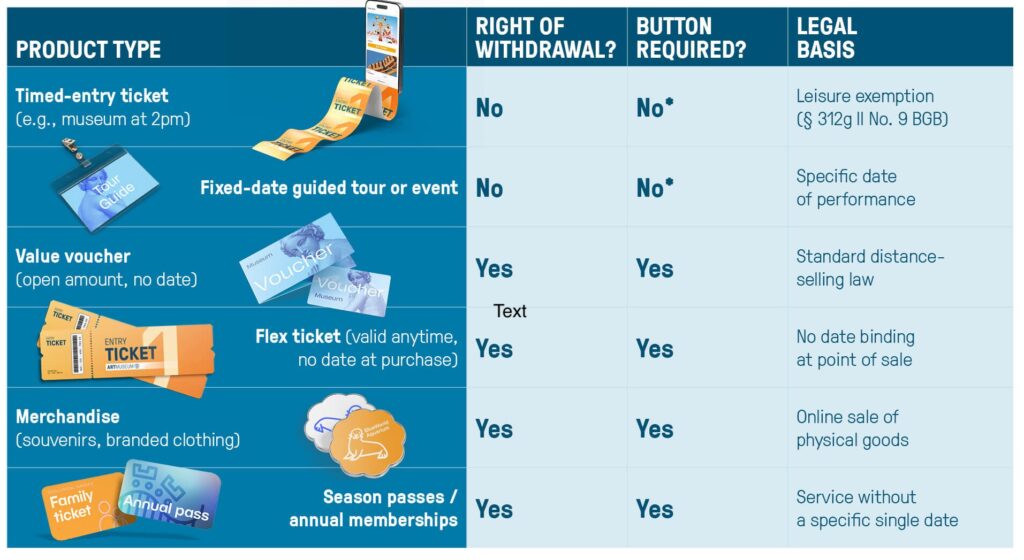
- Timed entry tickets (e.g., museum entry at 2pm)
- Fixed-date guided tours or events
What it does not cover — and this is where many operators are exposed without realising it:
- Value vouchers (open amount, no fixed date)
- Flex tickets and open-dated passes
- Season passes and annual memberships
- Merchandise sold online (branded clothing, souvenirs, etc.)
The moment any of these items appear in your shop, the full body of distance-selling law applies to them. And that means you need the Withdrawal Button.
The risk of getting it wrong is significant. Failure to comply can result in warnings from consumer protection groups (Abmahnungen) and serious fines of up to €50,000 — or up to 4% of annual turnover for larger businesses in Germany as an example.
The Quick Compliance Check: Your Product Matrix
Use this table to assess your exposure at a glance:
What the Law Actually Requires: The Two-Step Process
Compliance isn’t just about having a button. The law prescribes a specific two-click flow that must be accessible on every page of your online presence — not buried in a footer, not hidden behind a login.
Step 1: A clearly labelled button or link — for example, “Withdraw from contract” — is permanently visible across your website.
Step 2: Clicking it opens a simple form asking only for the details needed to identify the contract: name, order/booking number, and email address. Asking for a reason is not permitted as a mandatory field. The form ends with a second clearly labelled button: “Confirm withdrawal.”
Three additional requirements are easy to overlook:
No login wall. If a customer placed their order as a guest, the withdrawal path must be accessible without creating an account. The button cannot be locked behind a customer portal unless account creation was mandatory at the time of purchase.
Confirmation on a durable medium. A browser pop-up isn’t enough. The law requires an automated email confirmation with an explicit timestamp — this is the industry standard for legal certainty.
Timestamped documentation. Operators must be able to prove exactly when a withdrawal request was received. That record needs to be digital and legally sound.
Why This Also Applies to Systems, Not Just Products
If you run your ticketing on a non-European platform or a custom-built system, the compliance question goes beyond just your product catalogue. Many US-based or self-developed systems simply weren’t built with § 356a BGB in mind. And even if the intention is there, retrofitting a withdrawal flow into an existing checkout architecture before a hard deadline is technically complex.
The practical risk: a system that doesn’t automate the withdrawal workflow correctly — especially the eligibility check separating refundable from non-refundable items — exposes operators on the customer-facing side while leaving them without the back-office controls they need.
How bookingkit Handles This For You
bookingkit has built the compliance infrastructure directly into the platform with its new Cancellation Policies feature, available under Inventory in your dashboard.
The setup takes a matter of minutes:
- Go to Inventory → Cancellation Policies in your bookingkit dashboard.
- Click “Create Standard 14-day full refund policy” — this generates the legally required template automatically.
- Assign the policy to your eligible inventory: Flex Offers and open-dated tickets via the Assign to Inventory sub-tab; vouchers via the Vouchers tab (policies apply globally there, not item by item).
Once active, the system handles the rest: the withdrawal button appears dynamically on your customers’ self-service page for eligible items only, the two-step flow is built in, refunds route automatically back to the original payment method via Stripe, and freed-up slots are instantly returned to inventory for resale.
What this solves beyond compliance:
The automated flow eliminates what operators often call the “weekend gap” — the Sunday slot that stays empty because a cancellation email arrived Saturday night and nobody processes it until Monday morning.
Fixed-date tickets remain explicitly exempt and won’t be affected. Operators retain full control over which items a policy is attached to.
Note: bookingkit provides the compliance tooling, but the decision to activate it rests with you. Regulations are applied differently across EU member states, and we recommend consulting your legal team to confirm which products require activation under your specific jurisdiction.
Ready for June 19, 2026? Your Compliance Roadmap
The new EU Withdrawal Button requirement is a narrow but firm compliance obligation. Most experience operators will find it applies to some part of their business — even if their core product (timed tours, fixed-date events) is fully exempt.
The June 19 deadline doesn’t allow much runway. But with the right system in place, compliance doesn’t require manual effort or legal expertise on your end. It’s a one-time setup that also makes your operations measurably more efficient — fewer cancellation emails, no weekend backlogs, no dead capacity.
Already on bookingkit?
Set up your Cancellation Policy in your dashboard before June 19, 2026.
Working with a different system?
Many international or custom-built platforms weren’t designed with EU-specific regulations like § 356a BGB in mind — and retrofitting a compliant two-click withdrawal flow before a hard deadline is rarely straightforward. If your current setup can’t handle this automatically, now is a good time to review your options. bookingkit was built for exactly this market, with compliance infrastructure already in place.
Book a Demo
Frequently Asked Questions
Can I skip the button entirely if I only sell timed-entry tickets?
Technically, yes — if your product catalogue contains absolutely no vouchers, flex passes, merchandise, or memberships. In practice, the risk is high: the moment you launch a gift voucher or a branded item, you’re immediately exposed if the button isn’t in place. Building compliance now is significantly cheaper than fixing it reactively under legal pressure.
What happens with a mixed basket?
The withdrawal button must be globally accessible. When a customer uses it for a mixed order, the form should allow them to select which part of the order they want to withdraw from — the voucher, for example, but not the fixed-date tour ticket alongside it.
Does this apply to me if I’m based outside Germany?
EU Directive 2023/2673 is being implemented across all EU member states, though timelines and national implementations differ. The June 19 date applies specifically to the German implementation. If you operate in other EU markets, check the local transposition timeline for each country.
What if my Stripe balance doesn’t cover an instant refund?
If the platform balance is insufficient, an automated fallback alerts you in the back office and the customer is informed that processing may take up to 14 days via a manual refund path.
This article is for informational purposes only and does not constitute legal advice. We recommend consulting a qualified legal professional to assess your specific compliance obligations under the laws applicable to your business.

Frank Scheibe
Frank is a tours and activities industry expert. He reports on the latest facts, figures and trends in the bookingkit blog and the bookingkit newsletter. In his free time, he enjoys spending time with his kids and family, playing sports and eating good food.
Want to learn more about how bookingkit can help you drive conversions and get more bookings on your website?
Then get your free demo now.
Related articles
Product & Partners
Your website, fully equipped: the bookingkit AI Revenue Engine
The Revenue-boosting Webshop takes the booking The AI Sales & Support Agent wins the visitor who still has a question From now on, they work as one system Two people are on your website at the same time The first one knows exactly which ticket they want They pick a date, pay, and are done ...

Uncategorized
bookingkit Leisure Market Index – Q3 2026
Record level held: Europe's leisure market matches its all-time summer high, carried by higher prices rather than more visitors Each month, bookingkit analyses aggregated booking and revenue data from thousands of leisure providers across Europe The results for September and the full third ...

Product & Partners
The AI that doesn’t just answer questions. It closes bookings.
Meet the bookingkit AI Sales & Support Agent: the chat that turns a visitor's question into a paid ticket, without ever leaving the conversation It is 10 PM Someone is on your website, halfway to booking, and they have one question left Is there parking for a minibus Do the kids' tickets ...
Uncategorized
bookingkit and NaviPartner Form Strategic Partnership for End-to-End Attraction Technology
bookingkit, one of Europe's leading platforms for booking, marketing, and managing leisure experiences, and NaviPartner, the leading Danish Microsoft Solutions Partner for retail, attractions, and hospitality, are joining forces to give attractions a true one-stop shop By combining NaviPartner's ...
Industry & Trends
bookingkit Leisure Market Index – Q2 2026
Strongest second quarter on record: Europe's leisure market enters peak season with record revenue, returning demand and rising prices Each month, bookingkit analyses aggregated booking and revenue data from thousands of leisure providers across Europe The results for June and the full second ...
Industry & Trends
The Experience Operator’s Guide to the EU Withdrawal Button
The Experience Operator's Guide to the EU Withdrawal Button: What's Exempt, What Isn't, and How to Comply until June 19, 2026 June 19, 2026 is the date that every experience operator in Germany — and across the European Union — should have circled on their calendar That's when a new ...